
Amazon for Consumer Brands: How Established Companies Should Approach the Channel

Established consumer brands face a different Amazon problem than the entrepreneurs most Amazon advice is written for. Your products are likely already on the marketplace through resellers, your pricing affects relationships with every other retail partner, and your decisions involve channel strategy, not just tactics.
The brands that win on Amazon treat it as a managed channel: they choose the right selling model between 1P, 3P, and hybrid, control distribution before chasing growth, defend pricing architecture across channels, and resource the channel like the nine-figure opportunity it often is. This guide covers each of those decisions in the order an established brand should make them.
Why Amazon Is a Different Problem for an Established Brand
Here's the fact that reframes everything: your brand is already on Amazon whether you sell there or not. Unauthorized resellers, diverted inventory, and gray-market sellers create listings, set prices, and shape your brand experience without your input.
That means the first Amazon decision for an established brand involves control, not entry. An entrepreneur asks how to grow on Amazon. A brand manager has to ask who is currently representing the brand there, at what prices, and with what content.
Channel conflict raises the stakes further. Your Amazon price is visible to every buyer at every retail partner you have, so decisions that would be trivial for an Amazon-native seller ripple through your entire wholesale business.

1P, 3P, or Hybrid: Which Model Fits?
Selling 1P through Vendor Central means Amazon buys wholesale and retails your products itself. The model offers operational simplicity and the "Ships from and sold by Amazon" badge, but you surrender retail pricing control, and Amazon's algorithms decide what to order. Vendor Central remains invitation-only, and Amazon has been consolidating its vendor base since late 2024, exiting many smaller 1P relationships and reserving the program for larger suppliers.
Selling 3P through Seller Central keeps you in control of pricing, listings, and inventory, with FBA handling logistics. The trade-off is operational ownership: forecasting, account health, and compliance all become your job.
Many established brands land on a hybrid: core high-velocity catalog through 1P where it already works, with 3P for launches, premium lines, and anywhere pricing control matters most. The full decision framework lives in our Vendor Central vs Seller Central guide, but the short version is that the model should follow your margin structure and your need for pricing authority, never habit or inertia.
How Do You Protect Price Parity and MAP?
Start with the uncomfortable truth: Amazon does not enforce MAP policies. Amazon participates in no MAP agreements and prices its own 1P offers algorithmically against the broader market. Every MAP strategy that assumes Amazon's cooperation fails.
MAP enforcement is a distribution problem you solve upstream. Violations on Amazon trace back to product flowing through unauthorized channels, so the durable fix combines tightened distribution agreements, monitoring, and enforcement against the sellers breaking your policy. Our Amazon brand protection guide covers the enforcement toolkit in depth.
Parity cuts the other way too. Amazon's systems respond when an offer is priced uncompetitively against other channels, which can cost you the Featured Offer and merchandising eligibility. Your Amazon price architecture has to work within your whole channel ecosystem, a balancing act covered in our dynamic pricing strategy guide.
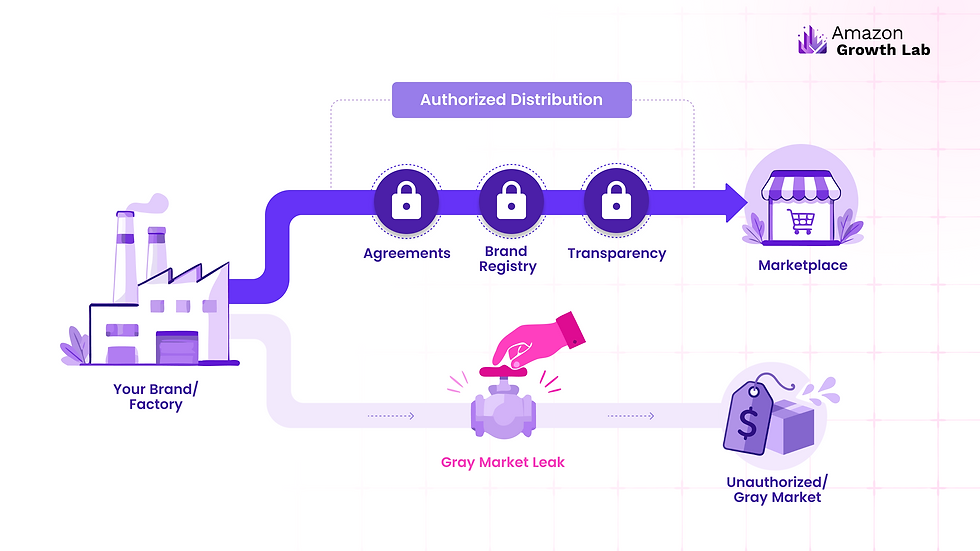
Lock Down Distribution Before You Scale
Growth investment on a leaky distribution base subsidizes your unauthorized sellers. Sequence control first.
Brand Registry is the foundation, giving you authority over listing content and access to Amazon's reporting tools for counterfeits and IP violations. For brands with persistent counterfeit or diversion problems, the Transparency program adds unit-level serialization that blocks fakes before they reach customers.
Pair Amazon's tools with commercial discipline: a clear authorized reseller policy, distribution agreements with online resale terms, and consistent enforcement. Brands that combine both layers shrink their unauthorized seller count quarter over quarter, while brands that rely on whack-a-mole takedowns alone fight the same battle forever.
Advertising at Brand Scale
Established brands inherit an advertising asset entrepreneurs spend years building: branded search volume. Defending it comes first, because competitors can and do bid on your brand name, intercepting demand your marketing already paid to create.
From there, the opportunity expands beyond the search results page. Sponsored Brands and Sponsored Display extend reach across Amazon, while Amazon DSP and Streaming TV put your brand in front of audiences far earlier in the journey, with Streaming TV available to sellers through the ads console with Brand Registry enrollment. The sequencing logic for these layers lives in our full-funnel advertising guide and the management discipline behind it in our Amazon PPC management guide.
The scale case is real. When we rebuilt Ray-Ban's Amazon presence, restructured listings and advertising lifted CTR from 0.02% to 20%, tripled conversion rate, and grew sales 1,477% in eight months. Established brand equity converts ferociously on Amazon once the channel fundamentals support it.

Who Should Own the Channel?
Amazon demands daily operational attention and quarterly strategic attention, and most consumer brands are staffed for neither. The channel touches pricing, supply chain, legal, and marketing at once, so "the ecommerce person handles it" breaks down as soon as volume matters.
Three models work. Full in-house ownership suits brands willing to hire dedicated Amazon specialists across advertising, operations, and content. Full agency management outsources the channel to a team that runs it daily, the model covered in our Amazon account management guide. The hybrid keeps strategy in-house while an agency runs execution, which is where many established brands settle.
Whichever you choose, evaluate it like a channel P&L owner. Our guide on how to hire an Amazon agency covers the questions that separate strategic partners from task-takers.
Frequently Asked Questions
Should an established brand sell on Amazon at all?
In most categories, yes, because your brand is already there through resellers, just without your pricing, content, or customer experience standards. Selling directly, or tightly controlling who does, converts an uncontrolled liability into a managed channel. The genuine exceptions are brands whose retail partner agreements or luxury positioning make marketplace presence strategically wrong.
What is the difference between 1P and 3P on Amazon?
In 1P, Amazon buys your inventory wholesale through Vendor Central and retails it, controlling price and logistics. In 3P, you sell directly to customers through Seller Central, keeping control of pricing, listings, and inventory, typically with FBA fulfillment. Vendor Central is invitation-only, and many established brands now run hybrid models using both.
Can Amazon enforce my MAP policy?
No. Amazon does not participate in MAP agreements, and its own 1P pricing responds algorithmically to the market. MAP enforcement on Amazon works upstream: control which resellers receive your product, write online resale terms into distribution agreements, monitor violations, and enforce against the sellers breaking policy. Brand Registry and Transparency support the Amazon side of that effort.
How do I remove unauthorized sellers from my Amazon listings?
There's no single removal button, so effective programs layer tools. Brand Registry enables reporting of counterfeit and IP violations, Transparency serialization blocks inauthentic units, and test buys document violations for enforcement letters. The lasting fix is upstream distribution control, since unauthorized offers persist as long as product keeps leaking into gray-market channels.
How much should an established brand budget for Amazon advertising?
Anchor the budget to TACoS targets and channel goals rather than a flat percentage. Defending branded search is comparatively cheap and nearly always worth funding first, while category growth and full-funnel layers like DSP scale with ambition. Established brands often find their conversion advantages make Amazon advertising more efficient than equivalent spend elsewhere.
Your brand deserves better than gray-market representation on Amazon. We help established consumer brands take control of the channel, from distribution cleanup to full-funnel growth. Talk to a channel strategist.
Not sure what's happening on your listings right now? We'll map your unauthorized sellers, pricing exposure, and untapped advertising position in one audit.


Comments