
How ChatGPT, Perplexity, and AI Overviews Are Surfacing Amazon Listings

Updated: Oct 5
A growing share of product discovery now happens outside Amazon's own search box entirely. ChatGPT, Perplexity, and Google's AI Overviews are pulling product information from the open web, including Amazon listings, brand sites, and comparison content, to answer questions like "what's the best" before a shopper ever types a query into Amazon. This is a different discovery layer from Amazon's own Alexa for Shopping, and it runs on different rules.
Amazon Isn't the Only Search Box Anymore
For years, optimizing for Amazon meant optimizing for Amazon's own search results, full stop. That's no longer the complete picture. Shoppers increasingly start their research in ChatGPT or Perplexity, or see an AI Overview at the top of a Google search, before they ever land on a product page.
Industry tracking from Adobe Analytics found that traffic referred from AI platforms to retail sites grew nearly 700% during the 2025 holiday season, and that traffic converted at meaningfully higher rates than traffic from traditional search. That's not a niche behavior anymore. It's becoming a standard part of how people shop.
This matters for Amazon sellers specifically because these AI tools don't ask Amazon for permission to reference your listing. They crawl what's publicly visible, on Amazon and elsewhere, and decide on their own what to summarize, compare, and recommend.

How ChatGPT, Perplexity, and AI Overviews Find Products
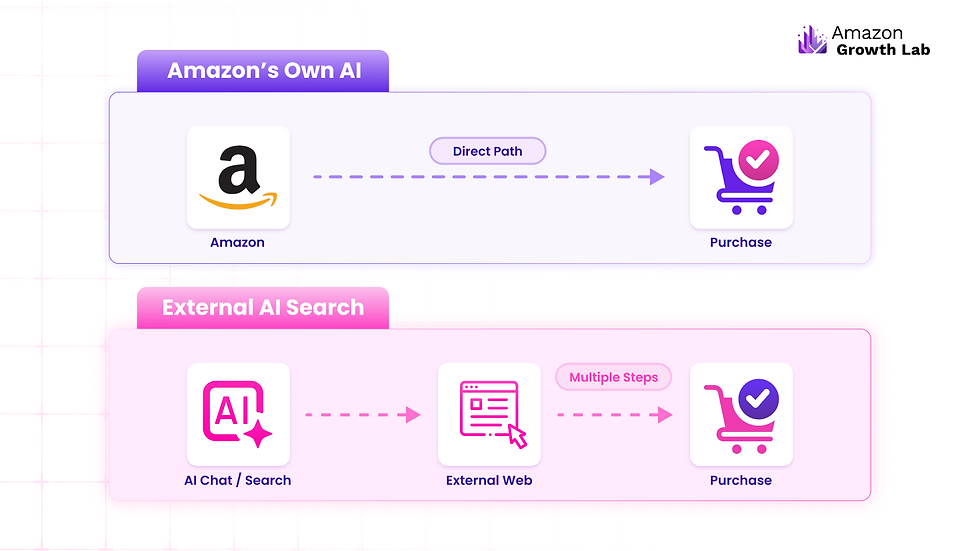
Unlike Amazon's own Alexa for Shopping, which has direct access to Amazon's full catalog, external AI tools work more like a very fast, very literal reader of the open web. They pull from retailer pages, brand sites, third-party reviews, and comparison content, weighing web visibility beyond just the retailer listing itself.
That means content living outside your Amazon listing, on your brand's own site, in comparison articles, in structured product feeds, carries real weight in whether these tools surface your product at all. A listing that only exists inside Amazon's ecosystem, with no supporting content elsewhere, is largely invisible to this discovery layer.
Structured data matters here too. Where structured product schema and feeds exist, AI tools increasingly route through them directly rather than relying purely on crawled text. Amazon Growth Lab's Amazon AI Optimization guide covers how structured data and schema markup support this broader discovery layer, beyond just what's needed for Amazon's own search.
This Is Different From Optimizing for Alexa for Shopping
It's worth being precise about the distinction here, since the two get conflated easily. Alexa for Shopping, Amazon's own AI shopping layer, has direct access to Amazon's product catalog and search infrastructure. Optimizing a listing for Alexa for Shopping is fundamentally still optimizing within Amazon's ecosystem.
ChatGPT, Perplexity, and Google's AI Overviews sit entirely outside that ecosystem. They discover your product the way a very thorough shopper would: by reading what's publicly available, comparing it against competitors, and forming an opinion based on what they can actually access and understand. Amazon Growth Lab's guide to Alexa for Shopping covers that Amazon-specific layer if you haven't reviewed it yet, since the two discovery channels genuinely require different strategies even though both fall under the broader AI-search umbrella.
Why Structured, Question-Driven Content Matters Again
Here's the part that should feel familiar rather than intimidating. The content practices that make a listing easy for an AI tool to summarize accurately are largely the same practices that make a listing easy for a human shopper to understand quickly: clear structure, direct answers to common questions, and language that states facts plainly instead of burying them in marketing copy.
Question-and-answer formatted content performs particularly well here, since it maps directly onto how people phrase queries to ChatGPT and Perplexity in the first place. A shopper asking "what's the best noise-canceling headphones for travel" is effectively asking a question your content could already answer directly, if it's structured to do so.
This is also why keyword-rich content, which some sellers had started treating as a lower priority once conversational search tools got better at understanding intent, is becoming relevant again in a different way. Without clear, specific language describing what a product is and does, an AI system has less to work with when deciding whether and how to recommend it. Amazon Growth Lab's guide to mining customer questions for SEO covers how to build that question-driven content structure directly from the questions your actual customers are already asking.
What Sellers Can Do About This
Start by auditing what content about your product actually exists outside your Amazon listing. If your brand has no supporting content elsewhere, no comparison mentions, no brand-site product pages, no structured feed, you're largely invisible to this discovery layer no matter how well your Amazon listing itself is optimized.
Next, build content that answers real comparison questions directly. Shoppers using ChatGPT or Perplexity to research a purchase are often explicitly comparing options, so content that clearly states what makes your product different, and for whom it's genuinely the right fit, gives these tools something concrete to work with.
Finally, don't treat this as a replacement for your existing Amazon listing optimization work. It's additive. A strong, clear, well-structured listing remains the foundation, and the practices that improve it for Amazon's own search generally improve its legibility for external AI tools too. Amazon Growth Lab's listing optimization guide remains the right starting point if your core listing content still needs work before layering on this broader strategy.

Getting Ready for a Channel That's Still Forming
This discovery layer is genuinely new, and the specific mechanics of how each AI tool weighs and ranks sources are still shifting. What's already clear is the direction: AI-referred shopping traffic is growing quickly, and it's converting at rates that make it worth paying attention to now rather than waiting for the picture to fully settle.
Brands that build clear, structured, question-answering content today aren't just betting on ChatGPT and Perplexity specifically. They're building the same foundation that tends to perform well across every AI discovery surface, including whichever ones matter most a year from now.
For the underlying mechanics of how AI systems read and select listings, the Amazon AI optimization guide covers the discovery layer in full.
Get Ahead of the AI Discovery Shift
If your product content only lives inside your Amazon listing, you're likely invisible to a growing share of how people are starting their shopping research.
FAQ Section
How is this different from optimizing for Amazon's Rufus or Alexa for Shopping?
Alexa for Shopping has direct access to Amazon's own catalog and search infrastructure, so optimizing for it is still optimizing within Amazon's ecosystem. ChatGPT, Perplexity, and Google's AI Overviews sit outside that ecosystem and discover products by crawling publicly visible content across the web, including but not limited to Amazon.
Do ChatGPT and Perplexity actually surface Amazon products?
Yes. These tools pull from the open web, including retailer pages, brand sites, and comparison content, when answering shopping-related questions. Products with little to no visibility outside their Amazon listing are harder for these tools to discover and recommend.
What kind of content helps my product get surfaced by AI search tools?
Clear, structured, question-driven content tends to perform best, since it maps directly onto how shoppers phrase questions to these tools. Comparison content that states plainly what makes your product different, along with structured product data where available, gives AI tools more to work with.
Should I stop focusing on Amazon SEO to prioritize this instead?
No. This is additive to your existing Amazon listing optimization work, not a replacement for it. The practices that make a listing clear and well-structured for Amazon's own search generally improve its legibility for external AI tools as well.
Is AI-referred shopping traffic significant enough to prioritize right now?
Industry data from Adobe Analytics found AI-referred traffic to retail sites grew nearly 700% during the 2025 holiday season, converting at notably higher rates than traditional search traffic. The channel is still forming, but the growth trend makes it worth building for now.

It’s interesting to see how AI tools are changing the way people discover products on Amazon, especially when shoppers increasingly rely on conversational answers instead of traditional search results. Sellers now need clear descriptions, useful information, and content that directly answers common customer questions. I’ve found https://aitextsummarizer.net/ helpful for turning lengthy articles and research into concise summaries that make key insights easier to understand. This can save time when tracking AI search trends and improving product content. Ultimately, useful information still makes the biggest difference.