
Amazon's 2026 Fee and Fulfillment Changes: DD+7 Payouts, Returns Processing Fees, and the End of Commingling

Updated: 4 days ago
Three separate 2026 policy changes are hitting FBA sellers' margins and cash flow at once. DD+7 now holds seller funds for seven days after delivery instead of after shipment. Returns processing fees apply per unit once a product's return rate crosses its category threshold.
And commingled inventory ended entirely on March 31, 2026, requiring most sellers to label every unit with an FNSKU barcode. None of these changes is catastrophic on its own, but modeled together, they change how much cash you actually have on hand at any given moment.
Three Changes Reshaping FBA Economics in 2026
Each of these changes arrived through a separate Seller Central announcement, on a separate timeline, which makes it easy to react to them one at a time instead of seeing the combined effect. That's the mistake worth avoiding here.
DD+7 changes when your money becomes available. Returns processing fees change how much of that money you actually keep. Commingling's end changes what it costs operationally to get inventory into Amazon's system in the first place.
Read separately, each is a line-item adjustment. Read together, they add up to a materially different cash flow picture than the one most sellers built their operations around.

DD+7: Why Your Payout Timeline Just Got Longer
DD+7 stands for Delivery Date plus 7 days, and its official name is Delivery Date Based Reserve. The policy took effect for North American sellers on March 12, 2026, after rolling out to European sellers in September 2025.
Here's the mechanism. Once a customer's order ships, Amazon collects the buyer's payment and holds it in a deferred transactions pool rather than crediting it to your available balance. The seven-day clock doesn't start until the carrier confirms delivery, not when the order ships. Only after those seven days pass does the money become eligible for your next disbursement.
The impact varies significantly depending on how fast your products actually reach customers. FBA sellers with fast Prime delivery windows can see funds become available in roughly nine days total, which is often faster than the old rolling 14-day cycle. FBM sellers with longer shipping times feel this far more, since a 10 to 14 day shipping window plus the seven-day hold can push total payout timing past 20 days.
This is exactly why cash flow modeling matters more now than it did under the old system. If you're still budgeting inventory purchases against a payout timeline that assumes funds land when an order ships, DD+7 will surface a gap you didn't plan for.
Amazon Growth Lab's guide to how often Amazon pays sellers breaks down the disbursement cycle mechanics in more detail if you need the baseline before layering DD+7 on top of it.
Returns Processing Fees: What Triggers Them and What They Cost
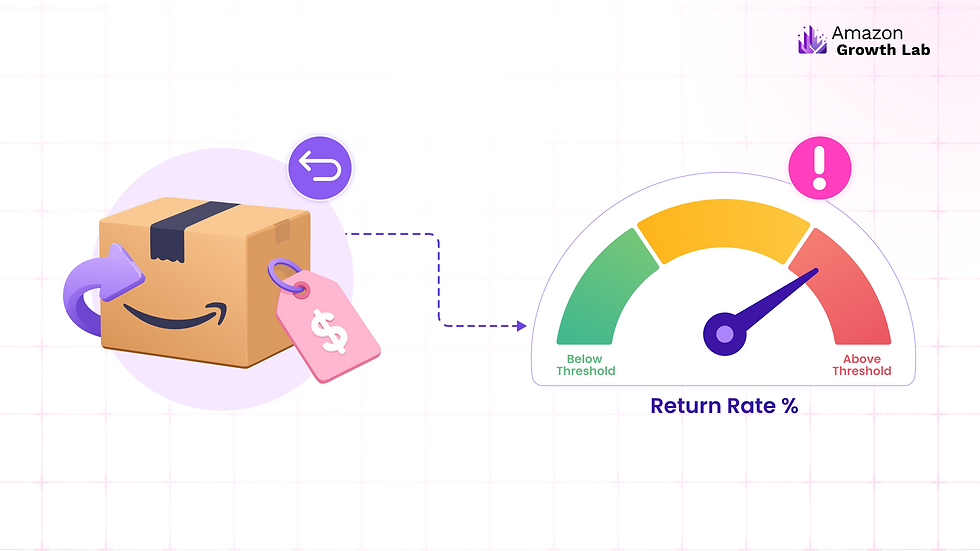
Returns processing fees aren't new, but their scope expanded significantly in 2026. The fee applies once a specific ASIN's return rate exceeds its category's threshold, typically somewhere in the 5% to 8% range depending on category, calculated against a three-month rolling window.
Most categories only charge the fee on units above that threshold. If your category's threshold is 10% and you shipped 1,000 units with 120 returned, the fee only applies to the 20 units above the 100-unit threshold, not all 120. Apparel and footwear work differently, with a fee charged on every returned unit regardless of your overall return rate.
The fee amount itself scales with size tier and category rather than being a flat rate. Fee updates can also change what you recover from restocking fees on returned items. This means a high-return-rate SKU in a heavier size tier can accumulate meaningful fees fast, even if your account-wide return rate looks unremarkable on a dashboard.
The most useful response here isn't disputing the fee structure, it's reducing what triggers it. Listing quality directly drives return rate, since unclear sizing information, misleading images, or incomplete product details are common causes of returns that better content could have prevented in the first place.
Amazon Growth Lab's listing optimization guide covers the content-quality levers that reduce returns before they ever generate a fee.
The End of Commingling: What the X00 Label Transition Means for You
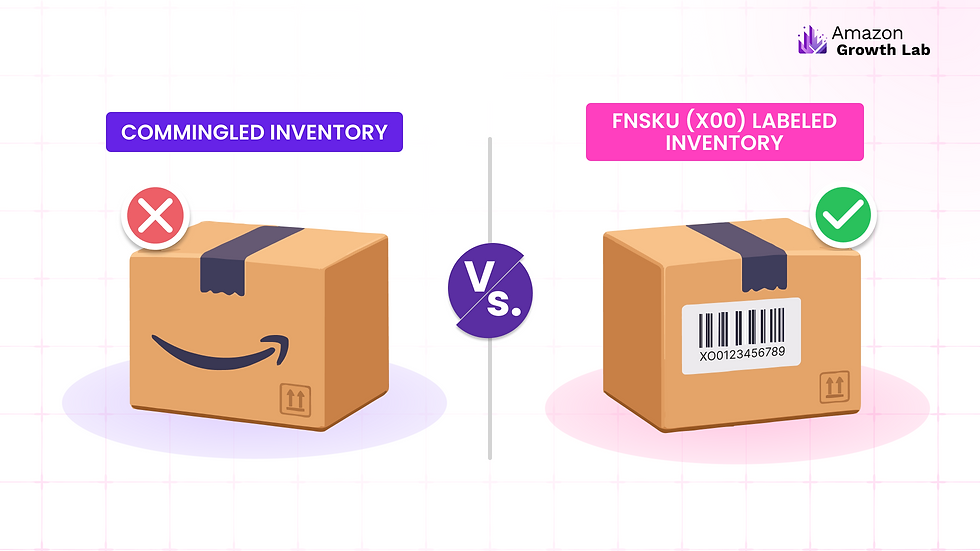
Commingled inventory, where Amazon fulfilled a customer's order using an identical unit from any seller carrying the same product barcode, officially ended March 31, 2026. Amazon's optional FBA prep and labeling service ended even earlier, on January 1, 2026, which compounds the transition for sellers who relied on that service.
Since the March 31 deadline, the labeling requirement has split based on seller status. Resellers and sellers without Brand Registry must apply an FNSKU barcode, which starts with the prefix X00, to every unit shipped to Amazon, even on products that already carry a standard manufacturer barcode.
Brand owners enrolled in Brand Registry with Brand Representative status get the opposite benefit: they're no longer required to sticker units purely to protect against commingling, since Amazon now tracks brand-registered inventory virtually using the manufacturer barcode instead.
The compliance risk is real if you miss the deadline. Non-compliant shipments received after March 31, 2026 can be marked defective, held, or made ineligible for reimbursement, which turns a labeling oversight into an inventory availability problem during exactly the kind of high-volume period where you can least afford one.
If you're not yet enrolled in Brand Registry, this is one more reason to prioritize it. Amazon Growth Lab's guide to Brand Registry enrollment walks through the process, and the labeling benefit alone can offset the enrollment effort for sellers currently applying FNSKU stickers manually.
Modeling the Combined Impact on Your Margins
Treat these three changes as one modeling exercise, not three separate line items. Start with DD+7 and calculate how many days of working capital you now need on hand before your next disbursement actually lands, based on your specific shipping speed rather than Amazon's blended average.
Next, pull your return rate by ASIN, not just account-wide, and compare each product against its category threshold. A single high-return SKU sitting well above threshold can be quietly eating margin that the rest of your catalog is masking.
Finally, factor in the labeling transition cost, whether that's the time and expense of applying FNSKU stickers as a reseller or the Brand Registry enrollment effort to avoid that cost entirely.
This is precisely the kind of margin-protection work that compounds. AGL's work with Ernst Grain, which scaled to $10M in Amazon revenue while cutting TACoS from 5% to 2.5% without increasing ad spend, shows what's possible when fee and margin management gets the same strategic attention as advertising does.
Amazon Growth Lab's FBA fee calculator is a useful starting point for modeling true per-unit profitability once all three of these changes are factored in.
What to Do Before These Deadlines Hit
DD+7 is already in effect, so the priority there is adjusting your cash flow planning immediately rather than waiting for a shortfall to force the issue. Review your current disbursement timeline against your actual shipping speed and build the buffer DD+7 requires into your inventory purchasing calendar.
For returns processing fees, pull your SKU-level return rates against category thresholds this week, not at the next quarterly review. A product quietly drifting above threshold compounds every month it goes unaddressed.
The commingling deadline gives you the most lead time, but also the most operational complexity to sort out. Audit your current FBA inventory now to determine what's commingled, decide whether Brand Registry enrollment makes sense before March 31, and build your FNSKU labeling workflow well ahead of the deadline rather than during it.
See What These Changes Actually Cost Your Account
Between DD+7, returns processing fees, and the commingling transition, most sellers are looking at a materially different margin and cash flow picture than they had a year ago. Get a free audit of your account and find out exactly where these changes are hitting your numbers.

FAQ Section
When did Amazon's DD+7 payout policy take effect?
DD+7 took effect for North American sellers on March 12, 2026, after rolling out to European sellers in September 2025. The policy holds seller funds for seven days after a carrier confirms delivery, rather than releasing funds based on when the order shipped.
What triggers an Amazon returns processing fee?
The fee applies once a specific ASIN's return rate exceeds its category-specific threshold, typically in the 5% to 8% range based on a three-month rolling average. Apparel and footwear are charged the fee on every returned unit with no threshold, while most other categories only charge it on units above the threshold.
What is the X00 label transition?
Commingled inventory ends March 31, 2026, requiring resellers and non-Brand Registry sellers to apply an FNSKU barcode, prefixed with X00, to every unit shipped to Amazon. Brand-registered sellers with Brand Representative status are exempt from this requirement and can continue using manufacturer barcodes instead.
Do I need Brand Registry to avoid FNSKU labeling costs?
Yes, if you want to avoid stickering every unit after March 31, 2026. Brand Registry members with Brand Representative status can use manufacturer barcodes for FBA inventory, since Amazon tracks their inventory virtually, while resellers and unregistered sellers must apply FNSKU labels to every unit.
How do these three changes affect my cash flow together?
DD+7 delays when funds become available, returns processing fees reduce how much of that revenue you keep, and the commingling transition adds labeling cost or Brand Registry enrollment effort. Modeling all three together, rather than reacting to each separately, gives a more accurate picture of your actual working capital needs.


Comments