
Scaling Amazon Business Past $1.5M: Breaking Through When Growth Stops

Updated: May 18
The Seven-Figure Ceiling That Traps Most Amazon Sellers
Your Amazon business hit $1.5 million in annual sales last year. That's phenomenal, you're among the most successful Amazon sellers on the platform. You've figured out sourcing, Amazon PPC, product listings, everything.
But you've been stuck at $1.5M for nine months now. You launched two new products. Both flopped. You increased ad spend 30%. Amazon sales stayed flat. You optimized your Amazon listing again. Nothing changed.
Every strategy that built your business from $0 to $1.5M has stopped working.
Welcome to the seven-figure plateau, where scaling from $1.5M to $3M requires completely different strategies than scaling your Amazon FBA business from $0 to $1.5M. The tactics that got you here actively prevent you from getting there.
At Amazon Growth Lab, we specialize in helping established Amazon FBA sellers break through these growth plateaus. The pattern is predictable: Sellers who built to seven figures through hustle and optimization hit a ceiling where working harder doesn't work anymore. Breaking through requires working differently.
The difference between sellers stuck at $1.5M forever and sellers scaling Amazon business operations to $5M+ isn't work ethic or product quality. It's understanding which constraints are limiting your growth and addressing those specific bottlenecks systematically.
Why You're Really Stuck (The Five Growth Constraints)
This analysis is based on patterns we observe across client accounts managing their Amazon FBA business. Your specific growth constraints may differ.
Most sellers misdiagnose why they can't scale their Amazon business. They blame Amazon's algorithm, competition, or market saturation. The real constraints are structural. These five constraints typically appear in combination; most stuck sellers face 2-3 simultaneously.
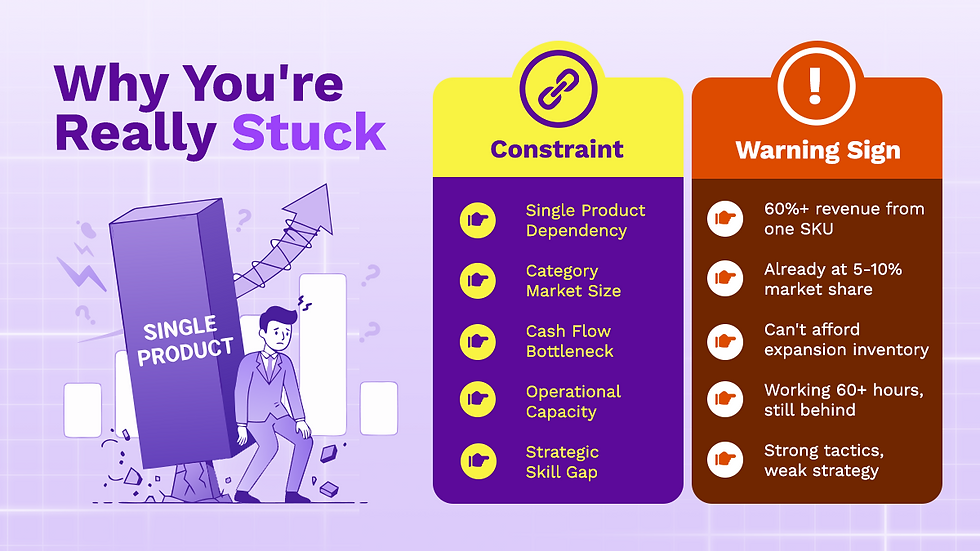
Constraint #1: Single Product Dependency
If one Amazon product generates 60%+ of your revenue, you're not stuck, you're fragile. That product is maxed out, and your business growth is capped by that product's total addressable market on the Amazon marketplace.
The math is unforgiving. If your main product generates $90K monthly and you're in a category with 50,000 monthly searches for your primary keyword, you've captured near-maximum market share. You can't scale that product to $150K monthly because the total market isn't big enough.
Sellers who built their Amazon FBA business to $1.5M on one hero product hit a ceiling when that product saturates its market. Scaling requires expanding your product line, but they don't know how because all their expertise is tied to managing one successful Amazon product.
Constraint #2: Category Market Size
You've optimized everything, you rank #1 for your main keywords through solid Amazon SEO, your conversion rate is 15%, your ACoS is 18%. Perfect execution. But you're still stuck.
Because you've maxed out your category's market size on Amazon.
Check your category size using product research tools like Jungle Scout or Helium 10:
Go to your product research tool
Research your main category
Look at total monthly revenue across top 100 sellers
Multiply by 12 for annual market size
The exact process varies by tool. Most product research tools provide category revenue estimates.
If your Amazon sales already represent 5-10% of total category revenue, you've captured a significant share. Further growth requires expanding to adjacent categories, creating new sub-categories, or diversifying into complementary products.
Constraint #3: Cash Flow Bottleneck
You can't scale your Amazon FBA business because you can't afford the inventory. Every time you try to launch a new product or increase inventory depth, you run out of cash.
This is the hidden killer at seven figures for any online business. Your existing products generate enough profit to sustain themselves but not enough excess cash to fund expansion.
The numbers: To scale from $1.5M to $3M in Amazon sales, you need to fund $500K+ in additional inventory over 12 months. That's $42K monthly in new capital requirements above your current inventory budget. If you're generating $15K monthly in free cash flow, you're $27K short every month.
Constraint #4: Operational Capacity Ceiling
You're managing everything yourself or with one seller assistant or VA. Your day looks like:
Check Amazon PPC campaigns (1 hour)
Respond to supplier emails (1 hour)
Fix product listing issues and support cases (2 hours)
Review performance reports in Amazon Seller Central (1 hour)
Research new products (1 hour)
Handle customer service escalations (1 hour)
You're working 60+ hours weekly just maintaining current operations. Where do you find time to launch new products, optimize additional product listings, or explore new channels?
You're at the solopreneur operational ceiling. Scaling Amazon business operations requires building systems and teams, but you're too busy fighting fires to build infrastructure.
Constraint #5: Strategic Skill Gap
You're operationally excellent, you can optimize an Amazon listing, manage PPC campaigns, negotiate with suppliers. But scaling requires strategic skills you haven't developed:
Brand building (vs. product selling) through Amazon Brand Registry
Portfolio management across 10+ SKUs
Team hiring and management
Systems creation and delegation
Multi-channel expansion strategy beyond just the Amazon store
You're stuck because the skills that got you here (tactical execution) aren't the skills that get you there (strategic planning). This is true whether you're running an Amazon FBA business or any ecommerce operation.
The Product Expansion Trap (Why Your Launches Keep Failing)
Most sellers trying to scale their Amazon business launch multiple new products. Here's why most fail:
Mistake #1: Random Product Selection
Your first product succeeded because you found an underserved niche with good demand and weak competition through product research. You got lucky.
Your next three products failed because you're using the same "gut feeling" research method. That worked once. It doesn't scale.
The Adjacent Product Matrix
Map your current customers' buying behavior:
What else do they buy after purchasing your Amazon product?
What complementary products solve related problems?
What would make your product more effective?

Example: You sell yoga mats. Your customers also buy:
Yoga blocks (60% purchase rate within 90 days)
Yoga straps (45% purchase rate)
Meditation cushions (30% purchase rate)
Launch yoga blocks first, highest attachment rate to your core customer base. You're not starting from zero; you're selling to existing customers who already trust you. This is smart sustainable growth strategy.
The Bundle Strategy
Instead of launching entirely new products, create bundles:
Yoga mat + block + strap = Premium Yoga Kit
Sell at 15% discount vs. buying separately
Tests product combinations before committing to inventory
If your bundle converts at 18%+ (vs. 12% for individual products on Amazon), you've validated demand. Now source inventory to sell bundle products individually with separate product listings.
Mistake #2: Undercapitalized Launches
Your first product succeeded with $10K total investment. You try launching your next Amazon product with $8K and wonder why it fails.
The market has changed. Competition among independent sellers increased 3x since your first launch. Amazon PPC costs doubled.
In competitive categories in 2025, successful launches typically require:
Product + shipping: $15,000-$25,000
Photography + infographics: $1,500-$3,000
Initial PPC budget: $5,000-$10,000 (first 90 days)
Giveaways/reviews: $2,000-$5,000
Total: $25,000-$45,000 per new product

These are typical ranges for competitive categories. Less competitive niches may require less.
If you're trying to launch with $10K, you're undercapitalized. You'll run out of ad budget before achieving ranking, reviews, or sales velocity on Amazon.
Mistake #3: Launching Outside Your Expertise
Your core product is in Home & Kitchen. You launch a supplement. It fails.
Why? Different categories, different customers, different compliance requirements, different competition level. You started over from zero instead of leveraging your existing strengths as an Amazon seller.
Successful expansion stays within your category or targets the same customer avatar through complementary products. Don't launch a completely new product for completely new customers in a completely new category. That's starting over, not expansion.
The Operations Scaling Blueprint
Phase 1: Document Everything (Week 1-4)
Track every task for two weeks: what you did, how long it took, how often, how critical. You'll find 60% of time goes to low-value tasks, 40% to high-value tasks.

Phase 2: Systematize Repeatable Tasks (Week 5-12)
Create SOPs (Standard Operating Procedures) for anything you do more than once weekly. An SOP is a Google Doc with: when to do this, step-by-step instructions, what "done" looks like, who to ask if stuck.
Goal: Anyone with basic Amazon knowledge could follow your SOP and complete the task 80% as well as you.
Phase 3: Hire For Your Weakest High-Value Skill (Month 4-6)
First hire options ranked by ROI for scaling Amazon business:
PPC specialist ($2K-$5K/month): High ROI if wasting 20%+ of ad spend
Operations manager ($3K-$6K/month): Frees 20+ hours weekly
Product researcher ($2K-$4K/month): Data-driven opportunity identification
VA for customer service ($800-$1,500/month): Handles routine tasks
Don't hire a VA to answer customer emails while you manage Amazon PPC. Hire a PPC expert while you develop strategy through Amazon business analytics.
Phase 4: Build Systems That Scale (Month 7-12)
Create dashboards with alerts for managing by exception:
PPC alerts: ACoS 10+ points above target, keywords with 50+ clicks and zero conversions
Inventory alerts: SKUs with less than 30 days inventory, 90+ days excess inventory
You're not checking Seller Central daily. You're reviewing alerts and making strategic decisions about your Amazon FBA seller operations.
The Cash Flow Solution for Scaling
You can't scale without capital. Here's how to fund expansion of your Amazon business:
Strategy 1: Profit Allocation Formula
Don't reinvest 100% of profits from your Amazon sales. Use this formula:
Monthly profit allocation:
50% → New inventory for existing products
30% → New product launches
20% → Cash buffer / tax savings
This balances growth with stability for your online business. Adjust percentages based on your situation.
Strategy 2: Inventory Efficiency Improvements
Faster inventory turnover through better inventory management frees cash for expansion.
Current state: 90 days of inventory on hand
Optimized state: 45 days on fastest-turning products, 60 days on moderate, liquidate slow movers
If you have $200K tied up in inventory at 90-day turn, optimizing to 60-day turn frees $67K in working capital, enough to launch 2-3 new products.
Strategy 3: Prioritized Expansion
Don't launch 5 products simultaneously. Launch 1-2, prove success, use profit to fund the next. This is how smart FBA sellers scale sustainably.
Timeline:
Q1: Launch Product A ($30K investment)
Q2: Product A breaks even, profits fund Product B ($35K)
Q3: Products A+B generate $8K monthly profit, fund Product C ($40K)
Q4: Portfolio generates $15K monthly profit, fund Products D+E
This requires patience but avoids external capital or crippling debt while scaling your Amazon FBA business.
Strategy 4: Revenue-Based Financing For Scale
If you're confident in launch success and want to move faster, revenue-based financing (Clearco, Wayflyer, 8fig) or Amazon Lending funds inventory in exchange for a percentage of future sales.
Typical terms as of 2024-2025 (verify current rates):
$50K-$500K advanced
Repay 6-12% fee over 6-12 months
No equity given up
Approval based on sales history
Terms vary significantly by provider, research multiple options before committing.
Use this when you have proven launch success and need to accelerate timing (like Q4 scaling). Don't use it to fix a broken business model.
Breaking Past $1.5M: The Actual Strategy
Here's the systematic 12-month approach for scaling Amazon business operations:

Quarter 1: Foundation Building
Document all operations (SOPs)
Analyze product portfolio (kill worst-performing 20%)
Free cash and time for expansion
Quarter 2: First Expansion
Launch 1-2 adjacent products targeting existing customers
Hire first specialist in your weakest high-value skill
Build PPC and inventory management systems
Quarter 3: Systematization
Create dashboards and alerts
Document specialist roles and workflows
Launch 1-2 more products if Q2 launches succeeded
Build 60-day cash buffer
Quarter 4: Scaling
Portfolio of 8-12 products (not 3-4)
Team handling execution while you focus on strategy
Revenue distributed across portfolio (no single product over 40%)
Cash flow stable due to buffer and systems
Realistic outcome with systematic execution: $1.5M → $2.5M-$3M within 12-18 months.
Individual results vary based on category, competition, and execution quality.
Notice this doesn't rely on luck or secret tactics. It's systematic execution of fundamentals while building operational capacity. This is how real Amazon FBA sellers achieve sustainable growth.
This isn't fast. But it's sustainable. Sellers who try jumping from $1.5M to $5M in 12 months usually crash back to $1M when they run out of cash or operational capacity.
When Scaling Past $1.5M Requires Expert Help
Breaking through the seven-figure plateau while maintaining operational sanity shouldn't be a solo journey. At Amazon Growth Lab, we specialize in helping established sellers systematically scale their Amazon business from $1.5M to $5M+.
How We Help Sellers Break Through Plateaus
Portfolio Strategy Development
We help clients identify high-potential adjacent products using data-driven analysis of customer purchase behavior, market trends, and category opportunities on Amazon. Our systematic approach to product research typically identifies 3-5 validated opportunities with strong revenue potential within 60 days.
Operational Systems Implementation
We build the Amazon PPC management systems, inventory management dashboards, and operational workflows that allow sellers to scale beyond personal capacity. Clients typically reclaim 15-20 hours weekly while improving performance, enabling them to leverage Amazon advertising more effectively without burning out.
Strategic Account Management
Beyond tactics, we provide the strategic guidance that solopreneur sellers lack, portfolio management across your product line, cash flow planning, team building strategy, and multi-channel expansion beyond just your Amazon store.
Our Track Record
Ernst Grain: Scaled to $10M with 2.5% TACoS through strategic portfolio expansion
Ray-Ban: 1,477% sales increase in 8 months via systematic product launches
98% client retention rate
Managing hundreds of millions in Amazon sales
When you're stuck at $1.5M despite profitable products and solid execution, or when you want to scale your Amazon FBA business without working 80-hour weeks, professional account management provides the systems, strategy, and execution capacity to break through and achieve sustainable growth.
Frequently Asked Questions
How long does it take to scale from $1.5M to $3M?
Realistically, 18-24 months with systematic execution for most Amazon FBA businesses. Faster growth is possible but usually comes at the cost of sustainability, burning cash, accumulating debt, operational chaos.
Sellers who scale steadily with proper systems and inventory management maintain that growth long-term. Sellers who spike fast using aggressive tactics often crash back within 12 months when the supply chain breaks or cash runs out.
Should I focus on scaling existing products or launching new ones?
Both, sequentially. First, optimize existing Amazon products to maximum efficiency, kill losers, double down on winners, improve product listings and Amazon PPC. This typically adds 15-25% revenue without new inventory risk.
Then launch new products to fill portfolio gaps and expand your product line. Launching new products while existing ones are inefficient wastes resources and dilutes focus on what actually works in your Amazon store.
How many products do I need to reach $3M in sales?
Typically 8-15 active SKUs with diverse revenue distribution across your Amazon FBA business. Based on our experience with stable seven-figure sellers:

Ideal portfolio for an FBA business:
No single product over 40% of revenue
Top 3 products represent 50-60% of total Amazon sales
Bottom 50% of SKUs generate 20-25% of revenue
This provides stability while concentrating on proven winners. It protects you if Amazon's algorithm changes hurt one product listing or if a competitor disrupts your main product.
What's the biggest mistake sellers make when trying to scale?
Trying to grow faster than their operational capacity or cash flow allows. They launch 5 products simultaneously, hire 3 VAs for customer service, and triple ad spend, then run out of cash, can't manage operations, and products fail because launches were undercapitalized.
Better to launch 2 Amazon products successfully than 5 products poorly. Sustainable growth beats rapid expansion that collapses.
Should I hire an agency or build an in-house team?
Depends on stage. At $1.5M-$2.5M, specialized agencies often provide better ROI than full-time hires for functions like Amazon PPC management. They bring expertise in Amazon business analytics and optimization that would take years to develop internally.
At $3M+, an in-house team becomes more cost-effective for your Amazon FBA business and provides better control. Hybrid approach works well: agency for specialized functions like PPC and Amazon SEO, in-house for operations and strategy.
How much should I spend on advertising when scaling?
Target 15-25% of revenue for advertising your Amazon business, increasing to 25-30% during new product launches. If you're spending 35%+ consistently, you have efficiency problems, not growth problems. Fix wasted spend before increasing the budget.
At $3M annual revenue, that's $450K-$750K annual ad spend. You need to leverage Amazon advertising efficiently, which means constantly optimizing campaigns, not just throwing money at the Amazon marketplace hoping for results.
What if I don't have cash to fund new product launches?
Focus on inventory management optimization first to free working capital. Kill slow-moving SKUs and discount aging inventory to raise $20K-$40K. Use the profit allocation formula to build launch capital over 2-3 quarters.
Consider revenue-based financing or Amazon Lending only after proving you can launch products profitably. Don't take expensive debt to fund unproven launches. Many small business owners make this mistake and destroy their profit margin trying to force growth.
When do I need to hire my first full-time employee?
When you're consistently working 60+ hours weekly on tasks someone else could do with training, and your time spent on strategic work is under 20% of total hours. For most Amazon sellers, this usually occurs at $2M-$3M revenue.
First full-time hire is typically an operations manager or PPC specialist who can manage day-to-day execution while you focus on strategy, product research, and sustainable growth. This is when your small business transitions into a real company.
How important is Amazon Brand Registry for scaling?
Critical for scaling beyond $1.5M. Amazon Brand Registry unlocks:
Enhanced product listings with A+ Content
Brand analytics showing customer behavior
Better protection against hijackers
Access to Amazon Stores for improved customer experience
Sponsored Brands ads (vs. just Sponsored Products)
Without Brand Registry, you're competing with one hand tied behind your back. It's essential infrastructure for any serious FBA seller planning to scale. The data from Amazon business analytics alone justifies the effort.
Should I expand to other channels besides Amazon?
Eventually, yes, but not until you've maximized your Amazon business first. At $1.5M-$3M, focus on dominating Amazon through better product listings, Amazon PPC optimization, and portfolio expansion.
At $3M+, consider expanding to Walmart, your own Shopify site, or other channels. But Amazon should remain 60-70%+ of revenue for most ecommerce businesses until you hit $5M+. Don't dilute focus too early by trying to build multiple sales channels simultaneously.
Multi-channel strategy sounds smart but often just means you're mediocre on multiple platforms instead of dominant on one. Master the Amazon marketplace first, then expand when you have the operational capacity and cash flow to support it.


Comments