
Amazon Visual Search Is Here: The New Science Behind High-Ranking Images

Updated: May 5
Picture this: a shopper snaps a photo of a product they spot in a store, at a friend's house, or in an Instagram post. Within seconds, Amazon Lens surfaces your listing, not your competitor's. They tap, convert, and you gain a sale you never would have captured through keyword search alone.
This scenario plays out constantly at scale across Amazon in 2026. Visual search on Amazon uses image recognition to match photos and patterns directly to catalog listings, bypassing traditional text queries entirely. When your images are optimized for visual search, you capture higher click-through rates, stronger conversion, and improved organic rankings.
The promise is straightforward: engineer images that rank high in Amazon's image-first world, and you unlock a traffic source most competitors ignore. Here's how to do it.
What Visual Search on Amazon Actually Is
Amazon Lens and camera-based search allow shoppers to photograph real-world objects and instantly find matching products in Amazon's catalog. The technology analyzes shapes, colors, patterns, and visual features to identify products without requiring any text input.
Visual search usage has surged as mobile shopping dominates. Shoppers increasingly prefer snapping a photo over typing product descriptions. This shift means image quality now matters as much as keyword optimization for capturing traffic and driving conversions.
Amazon's visual search works across categories, from furniture and fashion to electronics and home goods. Amazon’s A9 algorithm learns from millions of searches, continuously improving its ability to match photos to the right products. Sellers who optimize for this system gain access to buyers at the exact moment of intent.
The New Science Behind Image Ranking

Amazon's visual search algorithms analyze images through embeddings and pattern recognition. Each product image gets converted into a mathematical representation capturing visual features like shape, texture, color distribution, and structural elements. When a shopper searches with a photo, Amazon compares that photo's embedding against millions of product images to find the closest matches.
This connects directly to Amazon's ranking systems. Better images drive higher click-through rates because they appear more relevant in visual search results. Higher CTR leads to more conversions. More conversions increase sales velocity. Higher sales velocity improves organic search rankings.
The feedback loop is clear: optimize images for visual recognition, capture visual search traffic, convert at higher rates, and watch your organic rankings rise across all search types.
The Image Signals Amazon Cares About
Visual Clarity and Resolution
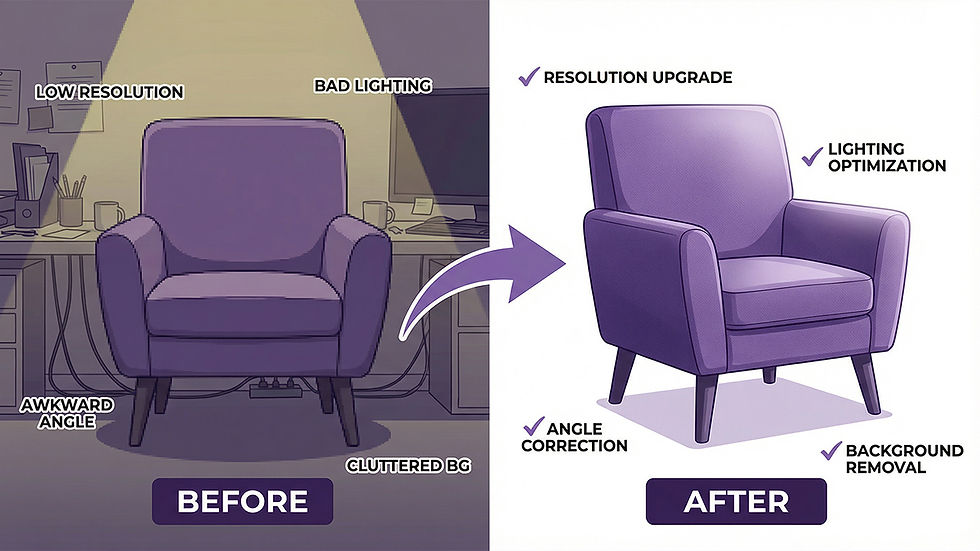
Sharp, high-resolution images improve Amazon's ability to recognize products and increase shopper confidence. Blurry or low-quality images confuse the algorithm and reduce click-through rates. At Amazon Growth Lab, we've found that upgrading image resolution alone can lift CTR by 15-20% in competitive categories.
Optimal specifications include 2000x2000 pixels or higher for best performance (Amazon's minimum is 1000x1000 but higher resolution maximizes visual search matching and zoom functionality), proper lighting that eliminates harsh shadows, and consistent white backgrounds for main images. Lifestyle images benefit from natural lighting and clean compositions that highlight the product without visual clutter.
Angle Coverage and Completeness
Multiple angles and product variations feed Amazon's algorithm more accurate data about your product's appearance. A shopper photographing a product from the side needs your listing to include side-angle images for a successful match.
Complete image stacks typically include front, back, top, side, detail shots, scale references, and lifestyle contexts. Each additional angle increases the likelihood of matching visual searches from different perspectives.
Consistent Branding and Visual Style
Cohesive logos, colors, and packaging help Amazon's algorithm cluster and associate your catalog. When your brand maintains consistent visual elements across product lines, the algorithm learns to recognize your products more reliably, improving match accuracy for visual searches.
This consistency also builds brand recognition with shoppers. When your images share a distinctive visual signature, repeat customers recognize your products instantly in search results, driving higher engagement and conversion rates.
How Visual Search Is Changing the SERP

Amazon increasingly runs image-first experiments where visual clarity and relevance can outweigh traditional ranking factors like review count and listing age. Products with superior images sometimes rank above competitors with more reviews when visual search traffic is high.
Lifestyle images, infographics, and on-image text influence both human behavior and machine understanding. Infographics that clearly show product dimensions, features, or use cases help Amazon's algorithm increasingly interpret structured information from images. Meanwhile, shoppers scanning results respond to visual clarity and information density.
The SERP is becoming a visual competition. Products that communicate value through images alone gain click-through advantages. Those relying on text-heavy listings without visual support lose ground as visual search becomes the dominant discovery method for certain categories.
High-Ranking Image Playbook
Step 1: Perfect Your Main Image
Your main image determines whether shoppers click or scroll past. Optimize composition, framing, and hero angle for instant recognizability. The product should fill 85% of the frame against a pure white background, positioned at a slight angle to show dimension.
Test different hero angles through Amazon's Manage Your Experiments. At Amazon Growth Lab, when we optimized Ray-Ban's main images as part of a comprehensive strategy refresh to show the product at a 15-degree angle rather than straight-on, CTR improved dramatically from very low single digits to double-digit percentages over eight months.
Step 2: Build a Complete Secondary Image Stack
Cover all angles, show scale, demonstrate use cases, and highlight key features visually. Secondary images should answer every question a shopper might have without reading text.
Essential elements include close-up detail shots, size comparison images with common objects, multiple lifestyle contexts showing different use cases, and back/side/internal views that reveal construction quality or hidden features.
Step 3: Create Scannable Infographics
Use minimalist, visually organized infographics that Amazon can increasingly interpret without overwhelming the algorithm. Keep text overlays to essential callouts
(dimensions, capacity, key benefits) using large, readable fonts.
Best practices include limiting text to 20-30 words per infographic, using icons and visual metaphors instead of dense copy, maintaining consistent color schemes that align with your brand, and organizing information in clear visual hierarchies.
Step 4: Optimize Every Product Variation
Each color, size, and style variation needs accurate, high-quality images. Generic placeholder images or reused photos confuse the visual search algorithm and reduce match accuracy.
When a shopper photographs a red version of your product, Amazon's visual search should surface the red variant specifically. This requires dedicated photography for every SKU, not just recolored versions of a single image.
Step 5: Mobile-First Optimization
Optimize cropping for vertical mobile screens, test zoom behavior to ensure detail visibility, and compress files without losing clarity. The majority of Amazon traffic comes from mobile devices, and visual search usage skews even higher on mobile.
Test how images appear on small screens by viewing them on actual phones. Details visible on desktop often disappear on mobile. Adjust compositions to ensure key product features remain clear at thumbnail size.
Visual Search, Rufus, and AI Shopping Assistants
Visual search now works alongside chat-style discovery through Amazon's Rufus AI assistant. Shoppers can photograph a product, then refine results using natural language queries like "show me this in blue" or "find something similar but cheaper."
This integration means your images need to work with AI-powered discovery. Natural, conversational copy in your listings helps AI assistants understand context. Descriptive text overlays on images (used sparingly) give AI systems additional signals for matching and recommendation.
The combination of visual and conversational search creates new discovery paths. A shopper might start with a photo, narrow results through conversational refinement, then make a purchase decision based on images alone. Optimizing for this multi-modal journey requires alignment between visual elements and textual descriptions.
Testing and Iterating Your Images
Use Amazon's Manage Your Experiments to A/B test different main images. Track CTR, conversion rate, and organic ranking movement over 14-30 day periods. Small improvements in main image performance compound into significant ranking and revenue gains.
Monitor shifts in impression sources through Brand Analytics. As Amazon expands visual search capabilities, you should see growing traffic from image-based discovery. If competitors gain ground in visual search results, audit your images against theirs to identify gaps.
Schedule quarterly image audits. Technology improves, consumer preferences shift, and competitors upgrade their creatives. Regular refreshes keep your listings competitive as visual search becomes more sophisticated.
At Amazon Growth Lab, we use our exclusive Amazon Poll network of 1000+ members to gather visual feedback before changes go live. This pre-testing eliminates guesswork and accelerates optimization cycles.
Partner with Visual Optimization Experts
Visual search optimization delivers maximum ROI when integrated with your complete Amazon strategy. At Amazon Growth Lab, we manage $100M+ in ad spend and have learned that images work as one element in a unified system.
When we rebuilt Ray-Ban's Amazon strategy, image optimization was critical. We upgraded product photography, restructured image stacks, and tested multiple hero angles. As part of a comprehensive transformation that included listing optimization across all 750+ data fields, PPC restructuring, and A+ Content enhancements, we achieved remarkable results: CTR jumped from very low single digits to double-digit percentages, and sales increased 1,477% over eight months.
Our Creative and Visual Services team includes professional product photographers, 3D rendering specialists, and infographic designers who understand Amazon's visual search algorithms. We don't just create attractive images. We engineer images that rank, convert, and integrate with your advertising and SEO strategy.
With 12+ years of Amazon expertise and a 98% client retention rate, we've optimized thousands of product listings for visual search. We know which image signals Amazon prioritizes, how to test systematically, and how to coordinate visual improvements with other ranking factors.
If you're using generic product photos, skipping lifestyle contexts, or treating images as decoration rather than ranking inputs, you're losing ground to competitors who understand visual search.
Ready to engineer images that rank?
Schedule a free listing audit and discover where your visual strategy is leaving traffic on the table.
Frequently Asked Questions
What image resolution does Amazon require for visual search optimization?
Amazon recommends a minimum 1000x1000 pixels, but for optimal visual search performance, use 2000x2000 pixels or higher. Higher resolution images provide Amazon's algorithm with more detail for accurate pattern recognition and improve zoom functionality for shoppers. At Amazon Growth Lab, we typically deliver images at 2500x2500 pixels to maximize visual search matching while maintaining fast load times through proper compression.
How many product images should I include for visual search?
Use all seven available image slots. Include one hero image on pure white background, 2-3 lifestyle images showing context and use cases, 2-3 detail/angle shots covering all perspectives, and 1-2 infographics highlighting key features and dimensions. More angles and contexts give Amazon's visual search algorithm better data for matching shopper photos to your listing.
Does visual search work for all product categories on Amazon?
Visual search works across most categories but performs strongest in visually distinctive categories like furniture, fashion, home decor, electronics, and sporting goods. Categories where products have unique shapes, colors, or visual patterns benefit most. Generic commodity products with minimal visual differentiation see smaller visual search impact but still benefit from improved image quality for traditional search.
How quickly will I see results from image optimization?
Initial CTR improvements often appear within 7-14 days as Amazon indexes your new images. Full ranking impact takes 30-60 days as the algorithm accumulates engagement data. At Amazon Growth Lab, we typically see measurable CTR improvements within two weeks and compounding ranking gains over 60-90 days as improved engagement signals feed back into organic rankings.
Can I use AI-generated product images for Amazon visual search?
Yes, but with caution. AI-generated images must accurately represent your actual product and meet Amazon's image requirements. AI tools work well for lifestyle contexts, background removal, and image enhancement. However, your main product images should be photographs of the actual item to avoid customer complaints and potential policy violations. AI enhancement of real photos typically delivers better results than fully synthetic images.
How does visual search affect my Amazon advertising?
Better images improve ad performance across all formats. Sponsored Products CTR increases when main images are optimized for visual clarity. Sponsored Brands video ads benefit from high-quality lifestyle footage. Images optimized for visual search often perform better in regular ads because they're designed for immediate visual recognition. At Amazon Growth Lab, we coordinate image optimization with PPC strategy to maximize efficiency across both organic and paid channels.
What's the difference between optimizing for visual search versus regular product photography?
Visual search optimization requires thinking like an algorithm, not just a photographer. Traditional product photography focuses on aesthetics and brand storytelling. Visual search optimization prioritizes clear angles, high contrast, consistent lighting, and complete coverage of all product aspects. The best approach combines both: aesthetically appealing images that also provide Amazon's algorithm with clear visual signals for accurate matching.
Should I update images on existing listings or only new products?
Update existing listings, especially your top performers. High-volume products get the most visual search traffic, so optimizing your bestsellers delivers immediate ROI. Start with products generating $50K+ annually, then work down your catalog. At Amazon Growth Lab, we typically see 15-25% CTR improvements on established listings after image optimization, which compounds into significant revenue gains on high-volume SKUs.

Action Checklist for Visual Search Optimization
Your 30-Day Visual Search Optimization Plan
Week 1: Audit Current State
Review all product images for resolution, clarity, and completeness
Identify top 20% of products by revenue (focus optimization here first)
Check competitor images in your category for visual gaps and opportunities
Document current CTR and conversion rates as baseline metrics
Week 2: Prioritize and Brief
Rank products by optimization urgency (high revenue + poor images = top priority)
Brief your photographer or AI tool with specific angle and context requirements
Create shot lists covering all angles, lifestyle contexts, and detail views
Establish brand visual guidelines for consistent style across catalog
Week 3: Execute Production
Shoot or generate new main images at 2000x2000px minimum resolution
Create lifestyle images showing product in realistic use contexts
Design minimalist infographics highlighting key features and dimensions
Photograph all color/size/style variations individually
Week 4: Upload and Monitor
Upload optimized images and use Amazon's A/B testing for main image variants
Track CTR, conversion rate, and organic rank movement daily for 30 days
Monitor impression sources in Brand Analytics for visual search growth
Schedule quarterly image refresh to maintain competitive advantage
Ongoing Optimization
Test new main images every 60-90 days on top products
Update lifestyle images seasonally or when use cases evolve
Add new angles or contexts based on customer questions in reviews
Monitor competitor image strategies and adjust accordingly
The Future of Amazon Is Visual
Sellers who treat images as search inputs rather than decoration will capture the next wave of Amazon traffic. Visual search is no longer experimental. It's core infrastructure that in our view is driving significant GMV.
The ranking algorithm now strongly weighs visual signals alongside keywords. Shoppers increasingly discover products through photos rather than text queries. AI assistants like Rufus combine visual and conversational search into seamless multi-modal experiences.
Your competitive advantage in 2026 comes from understanding that every product image is both a conversion tool and a ranking input. Optimize for human perception and algorithmic recognition simultaneously. Test systematically. Iterate continuously.
The brands winning on Amazon right now invested in visual optimization six months ago. The brands that will win six months from now are making those investments today.


Comments