
Amazon Inventory Management: The Growth Paradox That's Killing Profitable Sellers

Updated: May 5
Why Growing Amazon Sales Can Destroy Your Business
Your Amazon sales hit $150,000 last month, up 40% from six months ago. You should be celebrating. Instead, you're checking your bank account with a knot in your stomach. You have $8,000 in the bank. Amazon owes you $32,000 that won't arrive for another week. Your supplier needs $45,000 for inventory by Friday.
Welcome to the Amazon cash flow challenge: You pay for inventory weeks or months before Amazon pays you for the sale. The faster you grow, the wider this gap becomes.
At Amazon Growth Lab, we've watched profitable sellers nearly collapse from this timing mismatch. Understanding the cash conversion cycle is the difference between scaling to eight figures and shutting down at $2M.
The Amazon Cash Conversion Cycle
Here's a typical timeline for many FBA sellers who pay suppliers upfront and hold 60-90 days of stock:

Amazon pays every 14 days for orders delivered at least 7 days earlier, so you often see funds 2-4 weeks after the order. Your cash can be locked up for three months before returning.
Timelines vary by supplier location and payment terms. Sellers with domestic suppliers or negotiated terms experience shorter cycles. Some use daily-payout services to shorten their effective cycle further.
Why 40% Growth Feels Like Bankruptcy
Consider a seller growing 40% over six months with 40% COGS and upfront supplier payments:

In this scenario, you could easily need $80-90K more cash than you have. Your sales grew 61% but your cash deficit grew faster. Every additional sale requires funding more inventory before you've been paid for the last batch.
The Five Cash Flow Killers

1. Amazon's Payment Schedule:
Amazon pays every 14 days for orders delivered at least 7 days earlier. Meanwhile, suppliers want payment upfront. At $200K monthly sales, Amazon holds roughly $46,000 of your money at any given time.
2. The Inventory Timing Trap:
You order based on demand 90-120 days in the future. Guess wrong and you either stock out or tie up cash in excess inventory eating storage fees.
3. Fee Front-Loading:
FBA inbound fees, monthly storage fees, and aged inventory surcharges hit before products sell. You're paying Amazon on inventory that hasn't generated revenue yet.
4. Seasonal Cash Crunches:
A seller doing $50K monthly who wants 2-3x Q4 volume with 40% COGS might need $300K+ in inventory orders placed in July-September months before seeing that revenue.
5. Stranded Inventory:
Amazon's system occasionally marks inventory as "stranded" or "reserved" unsellable but still accruing storage fees. We've seen sellers with $50,000+ stuck for 4-6 months while support cases went nowhere.
The Working Capital Formula
Required Working Capital = (Monthly COGS × Cash Conversion Cycle in Months) + Safety Buffer
Example:
Monthly sales: $150,000
COGS (40%): $60,000
Cash conversion cycle: 3.5 months
Working capital needed: $60,000 × 3.5 = $210,000
Safety buffer (20%): $42,000
Total: $252,000

As a practical guideline, fast-growing businesses typically need 15-30% more working capital than stable businesses.
The Five-Step Cash Flow Survival Plan
Consult a financial advisor for advice specific to your situation.

Step 1: Map Your Actual Cash Conversion Cycle
Track your last 10 orders: date paid to supplier, date arrived at Amazon, average sale date, date Amazon paid you. Your real cycle may differ significantly from the 90-105 day average.
Step 2: Negotiate Supplier Terms
Offer larger volume commitments for better terms. We've helped clients move from 100% upfront to 30/70 split payments, freeing up $50K+ in working capital.
Approaches that work:
"If I commit to $200K over 6 months, can we move to 30-day terms?"
"I'll pay within 7 days instead of 30, but need 45-day terms on the next order."
Step 3: Target 45-Day Inventory Turnover
As a rule of thumb, aim for 45-day inventory turnover rather than 90 days.
Formula: Days of inventory = Current Inventory Value ÷ Daily COGS
Liquidate SKUs turning slower than 90 days. Accepting occasional stockouts on low performers beats tying up cash in excess inventory.
Step 4: Build a 20% Cash Buffer
Set aside 10-15% of monthly profit until you have roughly 20% of your working capital needs in reserve. This buffer transforms your ability to respond to demand spikes or supplier delays.
Step 5: Use Financing Strategically
Financing options by typical cost (2024-2025 verify current rates):
0% intro APR credit cards: 12-18 months interest-free
Revenue-based financing (Clearco, Wayflyer): 5-12% total cost
Amazon Lending: 6-16% APR (invitation-only, through partner banks)
Inventory financing (Kickfurther, 8fig): 5-10% for 90-180 days
Traditional line of credit: 8-15% APR
Merchant cash advances: 25-60% effective APR (emergency only)
Good uses: Confirmed Q4 orders, bridging payment gaps, validated product launches. Bad uses: Covering losses, surviving month-to-month, funding excess inventory.
When to Slow Growth
Red flags you're growing too fast:
Constantly near missing supplier payments
Stocking out on winners because you can't afford reorders
Using credit card cash advances for inventory
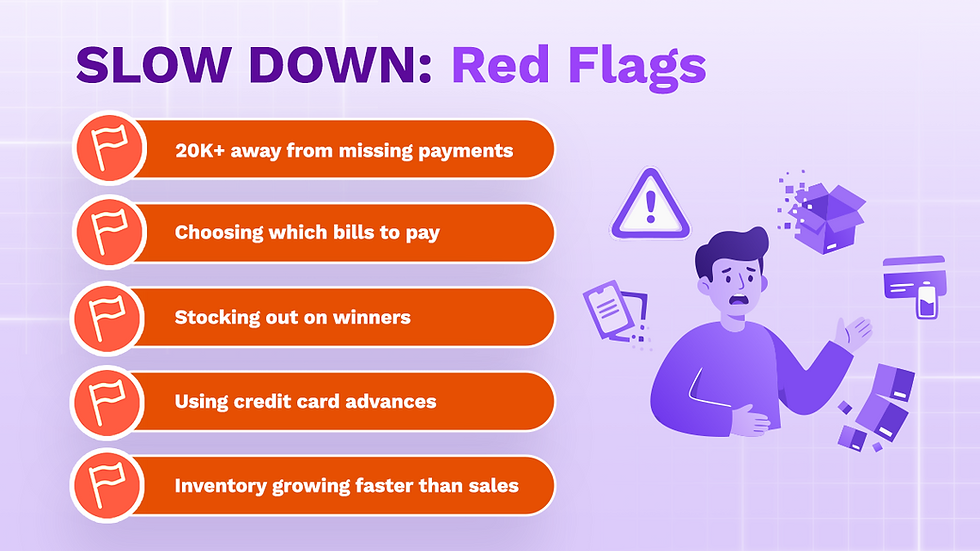
Sometimes the right move is maintaining current sales for 3-6 months while building your cash buffer. We've seen sellers scale to $3M, run out of cash, and shut down. Better to pause at $1.5M and build your foundation.
How Amazon Growth Lab Helps With Cash Flow
Managing Amazon's cash conversion cycle while scaling shouldn't threaten your business. At Amazon Growth Lab, we provide the systems and expertise to grow sustainably.
Strategic Inventory Management:
We help clients work toward 45-day inventory turnover, identify and liquidate slow movers, and forecast demand accurately across multiple SKUs. Our typical client frees up 15-25% of working capital trapped in excess inventory.
Supplier Term Negotiation:
We've helped clients move from 100% upfront payment to 30/70 split terms, immediately improving cash flow by $50K-$100K+ for larger accounts.
Account Health Protection:
Payment holds and ranking losses destroy cash flow during growth phases. We monitor account health, manage PPC efficiently, and optimize listings to keep your revenue flowing predictably.
Data-Driven Forecasting:
Using our proprietary tech stack combining Helium 10, Jungle Scout, and custom tools, we build demand forecasts that prevent both stockouts and excess inventory.
Our Track Record:
Ernst Grain: Scaled to $10M with 2.5% TACoS while maintaining healthy cash flow
Ray-Ban: 1,477% sales increase in 8 months with strategic inventory planning
98% client retention rate
Managing hundreds of millions in Amazon sales annually
Frequently Asked Questions
How much cash do I need to start an Amazon FBA business?
Minimum $15,000-$25,000 for a single product launch. To scale sustainably to $50K monthly revenue, plan for $75,000-$100,000 in working capital.
Why does Amazon hold my payments?
Amazon holds funds to cover returns, chargebacks, and A-to-Z claims. They pay every 14 days for orders delivered at least 7 days earlier. Maintain Order Defect Rate well below Amazon's 1% threshold to minimize extended holds.
What do I do if I've already run out of cash?
Immediately: Liquidate slow-moving inventory at cost, negotiate payment delays with suppliers, apply for 0% intro credit cards or revenue-based financing, and pause new launches. Focus on reordering proven winners only.
How can I tell if my cash flow problems are structural?
If you've had cash problems for 3+ consecutive months despite profitable sales, you're likely structurally undercapitalized. You need either more capital or better inventory control.
How important is inventory management software?
Critical for sellers with 10+ SKUs or $500K+ annual revenue. Good software provides real-time visibility, automated reorder points, and demand forecasting. It pays for itself by preventing one major stockout or excess inventory situation.

Comments