
.png)


Selling on Amazon at scale means managing far more than ads and listings. Every day, decisions are being made inside your Seller Central account that either compound your growth or quietly chip away at it - and most of them have nothing to do with which keywords you're targeting or how your main image looks.
Amazon account management is the operational and strategic discipline that keeps everything else working. It covers your account health score, your inventory position, your brand protection posture, your suspension risk, your FBA reimbursement recovery, your ability to escalate cases through Seller Support, and the quarterly business reviews that translate data into decisions.
When these systems are running well, your advertising performs better, your rankings hold, and your team spends its time building the business instead of fighting fires. When they break down, everything downstream breaks with them.
This guide covers the full scope of Amazon account management for established brands - what it involves, what it requires, and what happens when it's treated as an afterthought.

What Amazon Account Management Actually Covers
There's a common misconception that Amazon account management means checking Seller Central occasionally and responding to the occasional policy notice. At the brand level, it means running a continuous operating system across six interconnected domains.
The first is account health - the dashboard Amazon uses to score your policy compliance, customer service performance, and shipping metrics.
The second is inventory planning - the strategic layer of keeping products in stock without bleeding cash to excess storage fees.
The third is brand protection - enforcement against hijackers, counterfeiters, and MAP violators.
The fourth is compliance and suspension prevention - keeping your account out of the situations that halt revenue entirely.
The fifth is FBA reimbursement recovery - systematically claiming what Amazon owes you for lost or damaged inventory.
The sixth is analytics and business review - the reporting cadence that tells you whether your account is healthy and where the leverage points for growth actually are.
Each domain requires attention on its own. Together, they form the operational foundation that determines what your advertising and listing investments can actually achieve.

Account Health: The Metric Amazon Uses to Judge Your Business
Your Amazon Account Health Rating (AHR) is a numeric score ranging from 0 to 1,000. Amazon uses it to assess whether your account is in good standing, at risk, or eligible for deactivation. The score updates continuously based on your recent selling activity and any policy violations that have been logged against your account.
The three threshold zones matter:
200 to 1,000 - Healthy. Your account is not at risk of deactivation. The goal is to stay well into this range, not to hover near 200.
100 to 199 - At Risk. Amazon may restrict selling privileges and request a Plan of Action. An account in this range is under active scrutiny.
99 and below - Deactivation Eligible. At this level, any additional violation can trigger immediate suspension. Accounts in this zone must act on violations urgently.
New seller accounts start at 200. Points are added when you sell at volume without violations, and deducted when violations occur. Violations are tiered by severity - low, medium, high, and critical - and deductions range from 2 to 8 points per violation, with critical violations capable of dropping the score directly to zero.
Amazon also enforces repeat violation thresholds. For infringement-related policies, five violations within a 180-day window can trigger deactivation regardless of your overall AHR score. For restricted product policies, the threshold is two violations.
Amazon restructured how Featured Offer eligibility works in July 2026, and our breakdown of what the Featured Offer eligibility change means for sellers covers what to baseline before the rollout reaches your marketplace.

The Three Pillars Amazon Measures
Customer Service Performance centers on your Order Defect Rate (ODR) - the percentage of orders generating negative feedback, A-to-Z Guarantee claims, or credit card chargebacks over a 60-day rolling window. ODR must stay below 1%. Exceeding that threshold triggers immediate account health consequences. Practically, your target should be under 0.5% to maintain a buffer against isolated bad weeks.
Shipping Performance tracks your Late Shipment Rate, Pre-fulfillment Cancellation Rate, and Valid Tracking Rate. FBA sellers receive automatic perfection on shipping metrics since Amazon controls fulfillment - one of the operational reasons FBA makes account health management more predictable for brands at scale.
Policy Compliance is the broadest pillar and the one that generates the most unexpected violations. It includes listing policy violations, intellectual property complaints, product authenticity issues, restricted product flags, and review policy enforcement. This is the pillar where proactive monitoring matters most, because many violations originate from competitor complaints, not from anything your team actually did.
The color-coded dashboard in Seller Central - green for healthy, yellow for warning, red for action required - gives you a real-time snapshot of your account's standing. Violations that are resolved typically see score improvement within 24 to 48 hours, though some dashboard updates take longer to propagate.
For brands where the algorithm's ranking decisions are tied to account health signals, understanding how your AHR affects organic visibility is covered in the Amazon algorithm changes and recovery guide.

Inventory Management: The Strategic Layer That Protects Your Rankings
Inventory decisions are not just a logistics problem. They are a ranking problem. Amazon's search algorithm treats stockout events as negative performance signals. A product that runs out of stock loses its sales velocity data, loses its conversion momentum, and often requires weeks of advertising investment to rebuild the organic position it held before the stockout.
The strategic layer of inventory management - as distinct from the operational mechanics - involves three things: understanding your IPI score and its consequences, planning restock cycles that account for FBA receiving timelines, and calibrating your Q4 position without creating long-term storage fee exposure.
IPI Score and Restock Limits
Your Inventory Performance Index (IPI) score reflects how efficiently you're managing FBA inventory. Amazon uses it to determine your storage limits. Scores below Amazon's current threshold can result in restricted storage capacity at the worst possible time - before peak season, during a product launch, or following unexpected demand spikes.
The detailed mechanics of IPI scoring and how to improve it are covered in the IPI score guide. At the account management level, the key point is that IPI improvement comes from four levers: maintaining in-stock rates on high-velocity ASINs, reducing excess inventory on slow-moving ones, keeping stranded inventory at zero, and improving your FBA sell-through rate. All four require active monitoring rather than periodic review.
Avoiding the Stockout-Overstock Trap
The tension every FBA brand navigates is the risk of stocking out versus the cost of holding too much. FBA storage fees have grown more complex - standard fees, aged inventory surcharges, and low-inventory fees all create cost exposure on different ends of the inventory spectrum. Understanding the full fee structure as part of your inventory planning decisions is covered in the Amazon seller fees guide and the FBA fee calculator.
From a strategic planning perspective, your restock decisions need to account for FBA receiving timelines, which can range from a few days to several weeks depending on fulfillment center capacity. Brands that plan restocks based on Amazon's displayed lead times without buffer often find themselves shorting on stock during receiving delays. A working buffer of 2 to 4 weeks above your projected sell-through rate is a practical minimum for high-velocity ASINs.
Q4 Planning
Q4 requires a separate planning cycle, not just a scaled-up version of your standard restock process. Amazon's Q4 inventory cutoffs, the fee surcharges that apply to inventory remaining at fulfillment centers through January, and the demand volatility of November and December all create planning variables that don't exist in other quarters. Brands that build Q4 planning into their account management calendar in September - not November - avoid both the stockout exposure that kills holiday-season rankings and the post-season storage fee drag that follows over-ordering.
A full framework for the cash flow dimension of inventory decisions is in the inventory management and cash flow guide.

Brand Protection and MAP Enforcement
Building a brand on Amazon requires more than great products and strong listings. It requires an active defense posture against the unauthorized sellers, counterfeiters, and listing hijackers who treat established brands as opportunities.
Amazon Brand Registry in 2026
Amazon Brand Registry is the foundation of any brand protection strategy on Amazon. Enrollment requires an active or pending trademark from a recognized IP office. Once enrolled, your account gains priority authority over listing content - what appears in your titles, bullet points, images, and product descriptions is controlled by your team, not by whoever happens to be selling your ASIN.
The 2025 updates to Brand Registry significantly expanded its enforcement capabilities. The most important addition is Brand Catalog Lock, which lets brand owners lock key product detail fields - titles, images, bullet points, and descriptions - so unauthorized sellers and resellers cannot alter listing content. Only authorized representatives can make changes once a listing is locked. This addresses one of the most damaging forms of listing abuse, where third-party sellers modify product details in ways that mislead buyers and create account health exposure for the brand owner.
Amazon also enhanced the Report a Violation (RAV) tool with real-time status tracking for submitted infringement claims, and expanded the Transparency and Project Zero programs. Transparency now operates in 10 countries and had enrolled more than 88,000 brands as of 2026, verifying more than 2.5 billion product units as genuine. Project Zero enables self-service counterfeit removal for enrolled brands.
For the full walkthrough of Brand Registry enrollment, tools, and enforcement strategy, the Amazon Brand Registry guide covers the complete picture.
Hijacker Response
A listing hijacker is any unauthorized seller who adds themselves to your ASIN - often selling counterfeit units, gray market products, or other items that are not your genuine product. The immediate consequences are a lost Buy Box, potential negative reviews from customers who receive inferior products, and listing content that may be altered to reflect the hijacker's inventory.
For detailed tactics on identifying and removing hijackers, the hijacker removal guide covers the enforcement process step by step.
MAP Policy Enforcement
Minimum Advertised Price (MAP) policies protect your brand's pricing integrity and your authorized channel relationships. Amazon does not enforce MAP on your behalf - that responsibility falls to your team. When unauthorized sellers violate your MAP policy, the downstream effects include pricing pressure on authorized channels, margin erosion, and the kind of channel conflict that strains retailer relationships outside Amazon.
MAP monitoring requires external tooling - software that scans Amazon and other marketplaces for pricing violations and generates alerts. The enforcement response follows a graduated escalation: initial notices to violating sellers, formal cease and desist communication, and in persistent cases, supply chain investigation to identify how unauthorized inventory is entering the market. Brands that treat MAP as a set-and-forget policy rather than an active enforcement program consistently see grey market problems compound over time.

Suspension Prevention and the Appeal Process
Account suspension is the worst-case account management failure. Revenue stops completely, organic rankings erode without the sales velocity signals that maintained them, and the reinstatement process can take days, weeks, or in complex cases, months.
The most effective suspension strategy is prevention.
The Most Common Suspension Triggers in 2026
Policy violations are the leading cause. These include selling restricted products, listing products in prohibited categories, violating authenticity policies, and intellectual property complaints from brand owners. Amazon's enforcement has grown more aggressive in 2026, documentation requirements for inauthenticity and IP-related suspensions have increased substantially, and accounts facing these issues more frequently require multiple appeal rounds before reinstatement.
Performance metric failures - primarily ODR exceeding 1% - trigger account-level action regardless of AHR score. A single bad period can create immediate consequences.
Review policy violations are increasingly automated. Amazon's detection systems flag accounts based on statistical patterns in review behavior, customer communications, and sales-to-review ratios. Legitimate activities - manufacturer packaging inserts, third-party marketing services, customer service emails - can trigger flags if the pattern resembles manipulation to Amazon's algorithm.
Related account violations occur when Amazon's systems detect shared information between multiple seller accounts. These issues most commonly affect brands that have hired a third-party management company without ensuring complete account separation.
Building a Proactive Compliance System
A proactive compliance program reviews your account for exposure areas before violations are logged. This means auditing your product catalog for any ASINs that could attract authenticity complaints, reviewing your customer communication processes for anything that could trigger review policy flags, confirming that your product sourcing documentation is current and organized, and monitoring the Brand Registry enforcement dashboard for incoming IP complaints.
The goal is not just avoiding violations - it's being in a position to respond immediately and effectively when Amazon flags an issue. Amazon's enforcement timeline does not pause for business hours. Accounts that detect and begin addressing violations within hours of notification are in a meaningfully better position than accounts that discover issues days later.
Writing a Plan of Action That Works
If a suspension does occur, the appeal process centers on a Plan of Action (POA). A strong POA has three components: an acknowledgment of the root cause, a description of the corrective steps already taken, and a prevention plan that gives Amazon confidence the issue will not recur.
The most common POA failure is generic content. Amazon's review teams are reviewing thousands of appeals. A POA that does not specifically address the exact nature of the violation, that blames Amazon or the customer, or that consists of vague promises rather than specific procedural changes will be denied. Documentation requirements have increased substantially through 2026 - supply chain invoices, supplier authorization letters, logistics records, and product compliance certifications are now standard attachments for authenticity-related appeals.
For complex suspensions involving intellectual property complaints, Section 3 deactivations, or repeat denials, the process often requires escalation beyond the standard appeal pathway.
For a detailed resource on managing the suspension and reinstatement process, the Amazon account suspension guide covers the full spectrum from prevention to appeal.

FBA Reimbursements: Recovering What Amazon Owes You
Amazon's fulfillment network processes millions of shipments and handles billions of units. Inventory gets lost. Units get damaged before customer orders are placed. Processing errors occur during returns. In each case, Amazon has a policy obligation to compensate sellers - but recovering that compensation requires active management.
What Changed for 2026
Two significant policy changes have reshaped FBA reimbursement management for sellers.
The first, effective October 23, 2024, reduced the claim window from 18 months to 60 days for most reimbursement types. Before this change, sellers had a generous window to identify and file claims. Now, fulfillment center operations claims must be submitted within 60 days of the item being reported lost or damaged. Customer return claims have a window of 60 to 120 days after the refund or replacement date (for US sellers). Removal claims for items lost in transit must be filed within 15 to 75 days.
Amazon began proactively reimbursing sellers for certain categories of inventory loss - primarily items lost in fulfillment centers - which reduces manual filing burden for the most common scenarios. But removal claims and customer return mishandling still require manual intervention, and a meaningful percentage of eligible reimbursements go unclaimed under the automated system.
The second change, effective March 31, 2025, shifted how Amazon calculates reimbursement values for inventory lost before a customer order. The previous model, which approximated retail value, has been replaced by a manufacturing cost model. Amazon will either use its own estimate of manufacturing cost or use the figure you provide through the Inventory Defect and Reimbursement Portal. Sellers who do not submit their own manufacturing cost data risk receiving Amazon's estimate, which often falls significantly below actual cost.
Building a Reimbursement Recovery Process
Given the tightened claim windows, reimbursement recovery now requires a structured, frequent process rather than a periodic audit.
A working reimbursement system involves weekly reconciliation of inventory reports to identify discrepancies, a tracking mechanism for each ASIN's expected versus received quantities across FBA shipments, timely submission of any manual claims before the 60-day window closes, and accurate manufacturing cost data submitted to the Inventory Defect and Reimbursement Portal for all high-value ASINs.
For brands using FBA at scale, third-party reimbursement services that specialize in claim identification and filing can recover meaningful revenue that would otherwise be missed. The investment typically pays for itself many times over for accounts with significant FBA inventory volume.
Amazon's FBA reimbursement service is available through the AGL FBA reimbursements page.

Seller Support: Getting Cases Resolved When Amazon's Systems Fail
Amazon Seller Support is notoriously inconsistent. First-contact resolution rates are low, scripted responses are common, and the path to an agent with actual authority over your specific issue is often unclear. For brands that depend on Amazon revenue, knowing how to navigate the support system effectively is a practical necessity.
Choosing the Right Support Channel
Not all Seller Support contacts are equal. The channel you use affects both response time and the quality of engagement you receive.
For account health issues and compliance matters, the Account Health dashboard in Seller Central provides the most direct path to the specialized team reviewing your account. For listing issues and catalog problems, the specific issue type in the Help interface routes to the team with authority over that problem. Phone support typically reaches generalist agents; chat support can be faster for routine issues. For high-severity issues - account deactivation, listing takedown appeals, FBA reimbursement disputes - email submissions with detailed documentation outperform verbal escalations because they create a documented record that subsequent reviewers can reference.
Documentation Discipline
Every Seller Support interaction should be treated as a potential evidence record. Document case numbers, the specific claim or request submitted, the response received, and the date of each exchange. When a case requires escalation, referencing the prior case history with specific case numbers signals to Amazon's internal teams that the issue has already gone through standard channels without resolution.
For detailed escalation strategies for stuck cases, the Seller Support stuck cases guide covers the escalation pathway that moves issues from generalist agents to teams with actual resolution authority.
Common Situations Requiring Support Escalation
FBA receiving discrepancies - where inventory quantities received by Amazon do not match what was shipped - often require multiple case submissions with shipment documentation before they are resolved. Listing suppression issues sometimes persist even after the flagged content is corrected, requiring escalation to catalog teams. Stranded inventory that remains unresolvable through the Seller Central interface requires direct case submission with specific ASIN data. Reimbursement disputes where Amazon's automatic assessment is incorrect need to be appealed with documented manufacturing cost data and inventory reconciliation records.
New Product Launch Management: The Account Layer
A product launch has two layers: the advertising and promotional execution, which the PPC management pillar page covers, and the account management layer, which determines whether the product is set up correctly before a single ad dollar is spent.
The account management layer of a launch involves catalog setup, variation architecture, compliance verification, and the initial review acquisition strategy. Each has meaningful consequences if it's handled poorly.
Catalog Setup and Variation Strategy
The way a new ASIN is set up in Amazon's catalog affects its indexing, its relationship to existing parent listings, and the buy-box dynamics across variation children. A product launched under the wrong category, missing required compliance attributes, or improperly connected to a variation family will underperform regardless of advertising investment.
For products requiring compliance documentation - children's products, supplements, electronics with safety certifications - those documents need to be on file with Amazon before the listing goes live. Category requirements vary significantly, and the compliance review process can take time. Building compliance verification into the pre-launch timeline prevents the situation where a product is ready to ship but cannot be listed due to an outstanding documentation requirement.
Initial Review Acquisition
Amazon's review solicitation policies are specific and actively enforced. The "Request a Review" button in Seller Central is the only compliant mechanism for directly asking customers to leave reviews. Third-party inserts soliciting reviews, external email campaigns targeting buyers, or any form of review exchange violate Amazon's policies and carry suspension risk.
Early review velocity matters for conversion rate and for the algorithm's confidence in your new listing. Building a launch strategy that combines compliant review solicitation with high-velocity initial sales from advertising creates the feedback loop that gives a new product its best chance of establishing organic rank.
Analytics and Business Reviews: The Cadence That Drives Decisions
Data without review cadence is noise. The brands that compound their Amazon results over time have a structured review process that translates performance data into decisions on a defined schedule.
The Reports That Matter
Business Reports in Seller Central provide the foundational view of traffic, conversion, and revenue by ASIN. Conversion rate trends, unit session percentage, and buy box percentage are the metrics that tell you whether a listing is underperforming relative to the traffic it receives.
Brand Analytics unlocks deeper insight for Brand Registry-enrolled sellers. The Search Query Performance report shows impression share, click share, and purchase share by search term - the data that reveals whether you're winning or losing on the terms that matter most. The Market Basket Analysis shows which products shoppers frequently buy alongside yours, informing bundling and cross-sell decisions.
Inventory Reports track your stock position, aging inventory, and restock recommendations across your FBA catalog.
Account Health Dashboard provides the compliance and performance metric view across all three AHR pillars.
Quarterly Business Reviews
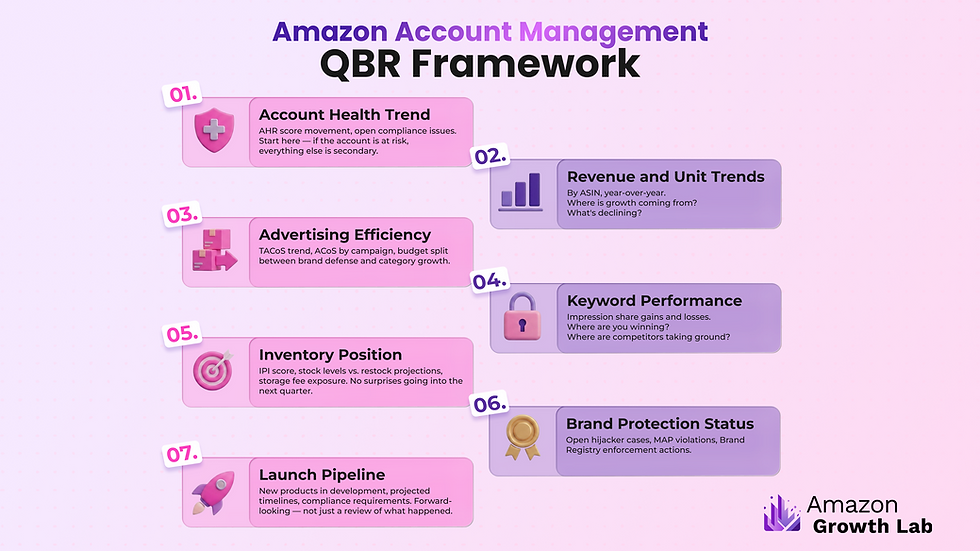
A quarterly business review (QBR) is the structured checkpoint that connects all of these data sources into a coherent picture of your Amazon business. An effective QBR covers:
-
AHR score trend and any open compliance issues
-
Revenue and unit trends by ASIN, with year-over-year comparison
-
Advertising efficiency - TACoS trend, ACoS by campaign, budget allocation between brand defense and category growth
-
Keyword performance - where you're gaining or losing impression share on primary terms
-
Inventory position - IPI score, current stock levels versus restock projections, any storage fee exposure
-
Brand protection status - open hijacker cases, MAP violations identified, Brand Registry enforcement actions
-
Launch pipeline - new products in development, projected launch timelines, compliance requirements
The QBR is where strategic decisions get made. Pricing adjustments, catalog rationalization, reallocation of ad budget to emerging opportunities, and decisions about which SKUs to sunset all belong in this review. Brands that operate without a structured QBR cadence tend to make these decisions reactively, in response to problems, rather than proactively in response to opportunity.
For the bigger picture on what strong account management makes possible, the scaling Amazon past $1.5M guide covers the strategic priorities that take brands from 7 figures to 8.
The Full-Service Integration Argument: Why Account Management Cannot Be Siloed
The most important thing to understand about Amazon account management is what happens when it's separated from advertising and listing optimization.
A brand managing PPC through one team and account health through another produces decisions that conflict. Ad spend gets scaled on ASINs with compliance flags that are about to trigger listing suppression. Inventory is under-stocked on the exact products where advertising is generating conversion velocity. Keyword data from advertising campaigns never flows back into listing updates. The teams are each doing their jobs; the account is not.
The same problem occurs when account management is delegated internally to a team member who monitors Seller Central as a secondary responsibility. The monitoring cadence is inconsistent, violations are caught late, support cases accumulate without resolution, and the reimbursement recovery process gets skipped entirely because there's no dedicated process for it.
At scale, these gaps are not minor inefficiencies. They are revenue and margin leakage that compounds month over month.
Full-service account management closes those gaps. Because advertising, listing optimization, inventory planning, brand protection, and account health are managed by the same team with visibility into the same data, the decisions connect. An account health flag on an ASIN gets caught before advertising spend is scaled on it. A keyword performing in PPC informs a listing update. An IPI score approaching the warning threshold triggers an inventory restock plan before it affects storage limits. The account operates as a system, not as a collection of independent workstreams.
Frequently asked questions

How Amazon Growth Lab Manages Amazon Accounts for Growing Brands
Amazon Growth Lab manages the full account management stack for 100+ brand clients across $100M+ in annual ad spend - not just campaigns and listings, but the account infrastructure that determines what those investments can actually produce.
That means daily monitoring of Account Health Rating, inventory position, and listing compliance. It means a structured FBA reimbursement recovery process running continuously alongside fulfillment operations. It means Brand Registry enforcement against hijackers and MAP violators, Seller Support escalation for stuck cases, and quarterly business reviews that connect advertising performance, organic ranking trends, and account health into a single strategic picture.
The Ernst Grain result - TACoS from 5% to 2.5%, revenue growth over 30% in 60 days, scaled to $10M - came from managing advertising, listings, and account operations as a connected system, not as independent work streams. Ray-Ban's 1,477% sales increase in 8 months required the same integration: advertising restructuring working alongside listing revamps and account-level brand protection, all moving in the same direction at the same time.
If your account health is showing flags you haven't fully resolved, your FBA reimbursements haven't been audited, or your brand protection posture is reactive rather than proactive, those are account management gaps - and they respond to systematic management.
Get a free Amazon account audit to see where your account infrastructure is leaking and what a structured management approach would change.